 Add to Chrome
 Add to Firefox
 Add to Edge
CaptchaMind: Training CAPTCHA Solvers via Reinforcement Learning with Explicit Reasoning Supervision
May 19, 2026
CAPTCHAs are widely deployed as human verification mechanisms and frequently block intelligent agents from completing end-to-end automation in real-world web environments. Solving modern CAPTCHAs requires robust multi-step visual reasoning and interaction capabilities, yet training-based approaches have remained absent due to the lack of large-scale training data and process-level annotations. We introduce CaptchaBench, the first CAPTCHA benchmark designed to support large-scale training, comprising 16,000 programmatically generated samples across eight task categories with detailed region and process-level annotations. Systematic evaluation on CaptchaBench reveals that existing methods fail consistently on tasks requiring fine-grained visual detail capture and region-level comparison. We therefore present CaptchaMind, an RL-based solver trained with explicit reasoning process supervision, achieving 82.9% average success rate across eight tasks and 71.0% on real-world instances, substantially outperforming all existing methods without closed-source APIs.

Geometric and Spectral Alignment for Deep Neural Network II
May 04, 2026This paper develops the angular and static-channel component of Geometric and Spectral Alignment for residual Jacobian chains. Starting from Cartan-coordinate rigidity and fitted effective-rank windows, we study how dominant singular subspaces are transported across adjacent layers and how the resulting finite matrices can be displayed in physical channel coordinates. The main results are deterministic, margin-verified results. We bound the error between full interface transport and its dominant-window truncation, add fitted-tail errors so that empirical spectra can be certified against the Gibbs--Cartan tail model, and distinguish source-mode incidence from fully physical input-output channel incidence. Given row groups and active supports, the Physical Alignment Matrix decomposes orthogonally as core plus overlap plus noise. Active-column gaps, pairwise overlap margins, and noise bounds combine into a static certificate radius under which the full transport and the truncated transport induce the same active supports, pairwise incidence graph, SRS sets, hub columns, and core/overlap/noise masks. The finer SC/SA/ST labels of the Invariant Channel Mapping require additional row-energy and profile-correlation margins, stated as explicit perturbation tests. The empirical section reports the matrices and block-energy heatmaps that measure these certificate quantities across CNNs, language models, and vision/diffusion backbones. The figures are interpreted as finite-dimensional measurements; complete membership in the Physical GSA certificate domain requires checking the numerical margin protocol stated in Section 10.
DiscreteRTC: Discrete Diffusion Policies are Natural Asynchronous Executors
Apr 27, 2026Unlike chatbots, physical AI must act while the world keeps evolving. Therefore, the inter-chunk pause of synchronous executors are fatal for dynamic tasks regardless of how fast the inference is. Asynchronous execution -- thinking while acting -- is therefore a structural requirement, and real-time chunking (RTC) makes it viable by recasting chunk transitions as inpainting: freezing committed actions and consistently generating the remainder. However, RTC with flow-matching policy is structurally suboptimal: its inpainting comes from inference-time corrections rather than the base policy, yielding little pre-training benefit, specific fine-tuning, heuristic guidance, and extra computation that inflates the latency. In this work, we observe that discrete diffusion policies, which generate actions by iteratively unmasking, are natural asynchronous executors that resolve all limitations at once: they are fine-tuning free since inpainting is their native operation, while early stopping further provides adaptive guidance and reduces inference cost. We propose DiscreteRTC, which replaces external corrections with native unmasking, and show on dynamic simulated benchmarks and real-world dynamic manipulation tasks that it achieves higher success rates than continuous RTC and other baselines. In summary, DiscreteRTC is simpler to implement with 0 lines of code for async inpainting, faster at inference with only 0.7x computation compared with generating actions from scratch, and better at execution with 50% higher success rate in real-world dynamic pick task compared with flow-matching-based RTC. More visualizations are on https://outsider86.github.io/DiscreteRTCSite/.
AgentSPEX: An Agent SPecification and EXecution Language
Apr 14, 2026Language-model agent systems commonly rely on reactive prompting, in which a single instruction guides the model through an open-ended sequence of reasoning and tool-use steps, leaving control flow and intermediate state implicit and making agent behavior potentially difficult to control. Orchestration frameworks such as LangGraph, DSPy, and CrewAI impose greater structure through explicit workflow definitions, but tightly couple workflow logic with Python, making agents difficult to maintain and modify. In this paper, we introduce AgentSPEX, an Agent SPecification and EXecution Language for specifying LLM-agent workflows with explicit control flow and modular structure, along with a customizable agent harness. AgentSPEX supports typed steps, branching and loops, parallel execution, reusable submodules, and explicit state management, and these workflows execute within an agent harness that provides tool access, a sandboxed virtual environment, and support for checkpointing, verification, and logging. Furthermore, we provide a visual editor with synchronized graph and workflow views for authoring and inspection. We include ready-to-use agents for deep research and scientific research, and we evaluate AgentSPEX on 7 benchmarks. Finally, we show through a user study that AgentSPEX provides a more interpretable and accessible workflow-authoring paradigm than a popular existing agent framework.
Mean Flow Policy with Instantaneous Velocity Constraint for One-step Action Generation
Feb 14, 2026Learning expressive and efficient policy functions is a promising direction in reinforcement learning (RL). While flow-based policies have recently proven effective in modeling complex action distributions with a fast deterministic sampling process, they still face a trade-off between expressiveness and computational burden, which is typically controlled by the number of flow steps. In this work, we propose mean velocity policy (MVP), a new generative policy function that models the mean velocity field to achieve the fastest one-step action generation. To ensure its high expressiveness, an instantaneous velocity constraint (IVC) is introduced on the mean velocity field during training. We theoretically prove that this design explicitly serves as a crucial boundary condition, thereby improving learning accuracy and enhancing policy expressiveness. Empirically, our MVP achieves state-of-the-art success rates across several challenging robotic manipulation tasks from Robomimic and OGBench. It also delivers substantial improvements in training and inference speed over existing flow-based policy baselines.
DADP: Domain Adaptive Diffusion Policy
Feb 03, 2026Learning domain adaptive policies that can generalize to unseen transition dynamics, remains a fundamental challenge in learning-based control. Substantial progress has been made through domain representation learning to capture domain-specific information, thus enabling domain-aware decision making. We analyze the process of learning domain representations through dynamical prediction and find that selecting contexts adjacent to the current step causes the learned representations to entangle static domain information with varying dynamical properties. Such mixture can confuse the conditioned policy, thereby constraining zero-shot adaptation. To tackle the challenge, we propose DADP (Domain Adaptive Diffusion Policy), which achieves robust adaptation through unsupervised disentanglement and domain-aware diffusion injection. First, we introduce Lagged Context Dynamical Prediction, a strategy that conditions future state estimation on a historical offset context; by increasing this temporal gap, we unsupervisedly disentangle static domain representations by filtering out transient properties. Second, we integrate the learned domain representations directly into the generative process by biasing the prior distribution and reformulating the diffusion target. Extensive experiments on challenging benchmarks across locomotion and manipulation demonstrate the superior performance, and the generalizability of DADP over prior methods. More visualization results are available on the https://outsider86.github.io/DomainAdaptiveDiffusionPolicy/.
WarmServe: Enabling One-for-Many GPU Prewarming for Multi-LLM Serving
Dec 10, 2025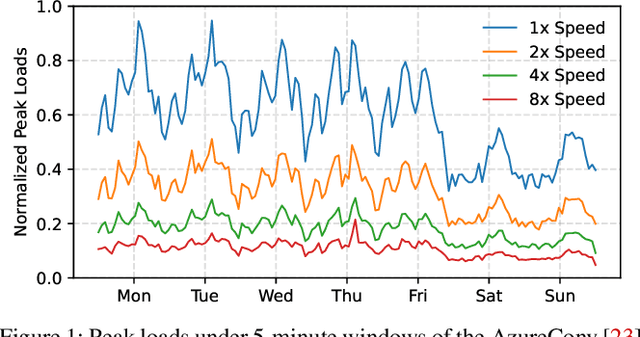
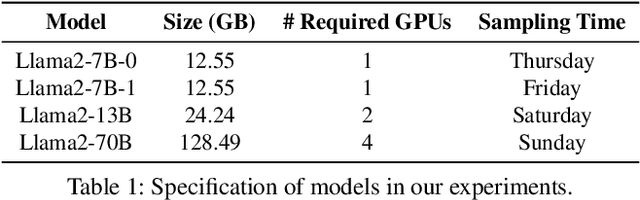
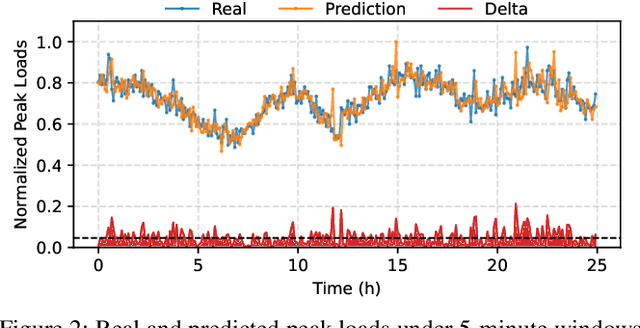
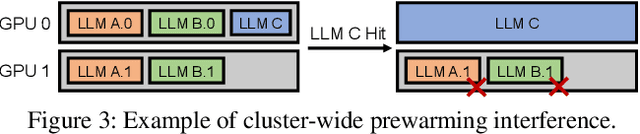
Deploying multiple models within shared GPU clusters is promising for improving resource efficiency in large language model (LLM) serving. Existing multi-LLM serving systems optimize GPU utilization at the cost of worse inference performance, especially time-to-first-token (TTFT). We identify the root cause of such compromise as their unawareness of future workload characteristics. In contrast, recent analysis on real-world traces has shown the high periodicity and long-term predictability of LLM serving workloads. We propose universal GPU workers to enable one-for-many GPU prewarming that loads models with knowledge of future workloads. Based on universal GPU workers, we design and build WarmServe, a multi-LLM serving system that (1) mitigates cluster-wide prewarming interference by adopting an evict-aware model placement strategy, (2) prepares universal GPU workers in advance by proactive prewarming, and (3) manages GPU memory with a zero-overhead memory switching mechanism. Evaluation under real-world datasets shows that WarmServe improves TTFT by up to 50.8$\times$ compared to the state-of-the-art autoscaling-based system, while being capable of serving up to 2.5$\times$ more requests compared to the GPU-sharing system.
CLO: Efficient LLM Inference System with CPU-Light KVCache Offloading via Algorithm-System Co-Design
Nov 18, 2025The growth of million-token LLMs exposes the scalability limits of inference systems, where the KVCache dominates memory usage and data transfer overhead. Recent offloading systems migrate the KVCache to CPU memory and incorporate top-k attention to reduce the volume of data transferred from the CPU, while further applying system-level optimizations such as on-GPU caching and prefetching to lower transfer overhead. However, they overlook the CPU bottleneck in three aspects: (1) substantial overhead of fine-grained dynamic cache management performed on the CPU side, (2) significant transfer overhead from poor PCIe bandwidth utilization caused by heavy gathering operations at the CPU side, and (3) GPU runtime bubbles introduced by coarse-grained CPU-centric synchronization. To address these challenges, we propose CLO, a CPU-light KVCache offloading system via algorithm-system co-design. CLO features: (1) a coarse-grained head-wise approximate on-GPU caching strategy with negligible cache management cost, (2) seamless combination of data prefetching and on-GPU persistent caching for lower transfer overhead, (3) a zero-copy transfer engine to fully exploit PCIe bandwidth, and a GPU-centric synchronization method to eliminate GPU stalls. Evaluation on two widely-used LLMs demonstrates that CLO achieves comparable accuracy to state-of-the-art systems, while substantially minimizing CPU overhead, fully utilizing PCIe bandwidth, thus improving decoding throughput by 9.3%-66.6%. Our results highlight that algorithm-system co-design is essential for memory-constrained LLM inference on modern GPU platforms. We open source CLO at https://github.com/CommediaJW/CLO.
ReCast: Reliability-aware Codebook Assisted Lightweight Time Series Forecasting
Nov 15, 2025Time series forecasting is crucial for applications in various domains. Conventional methods often rely on global decomposition into trend, seasonal, and residual components, which become ineffective for real-world series dominated by local, complex, and highly dynamic patterns. Moreover, the high model complexity of such approaches limits their applicability in real-time or resource-constrained environments. In this work, we propose a novel \textbf{RE}liability-aware \textbf{C}odebook-\textbf{AS}sisted \textbf{T}ime series forecasting framework (\textbf{ReCast}) that enables lightweight and robust prediction by exploiting recurring local shapes. ReCast encodes local patterns into discrete embeddings through patch-wise quantization using a learnable codebook, thereby compactly capturing stable regular structures. To compensate for residual variations not preserved by quantization, ReCast employs a dual-path architecture comprising a quantization path for efficient modeling of regular structures and a residual path for reconstructing irregular fluctuations. A central contribution of ReCast is a reliability-aware codebook update strategy, which incrementally refines the codebook via weighted corrections. These correction weights are derived by fusing multiple reliability factors from complementary perspectives by a distributionally robust optimization (DRO) scheme, ensuring adaptability to non-stationarity and robustness to distribution shifts. Extensive experiments demonstrate that ReCast outperforms state-of-the-art (SOTA) models in accuracy, efficiency, and adaptability to distribution shifts.
What's on Your Plate? Inferring Chinese Cuisine Intake from Wearable IMUs
Nov 07, 2025Accurate food intake detection is vital for dietary monitoring and chronic disease prevention. Traditional self-report methods are prone to recall bias, while camera-based approaches raise concerns about privacy. Furthermore, existing wearable-based methods primarily focus on a limited number of food types, such as hamburgers and pizza, failing to address the vast diversity of Chinese cuisine. To bridge this gap, we propose CuisineSense, a system that classifies Chinese food types by integrating hand motion cues from a smartwatch with head dynamics from smart glasses. To filter out irrelevant daily activities, we design a two-stage detection pipeline. The first stage identifies eating states by distinguishing characteristic temporal patterns from non-eating behaviors. The second stage then conducts fine-grained food type recognition based on the motions captured during food intake. To evaluate CuisineSense, we construct a dataset comprising 27.5 hours of IMU recordings across 11 food categories and 10 participants. Experiments demonstrate that CuisineSense achieves high accuracy in both eating state detection and food classification, offering a practical solution for unobtrusive, wearable-based dietary monitoring.The system code is publicly available at https://github.com/joeeeeyin/CuisineSense.git.